Thursday, January 13, 2011

Versace, Porsche Design, and Tiffany... Oh My!

On my way to an evening MCLE/Dinner Meeting to hear about the recent U.S. Supreme Court tie in the matter of Omega v. Costco and their failure to clarify what to do about the copyright first sale doctrine, I did some window shopping in Beverly Hills, Calif. early last nite.

And lo and behold, of course, I walked pass a gamut of Designer retail stores, including Famous Brand Names and Trademarks, namely: Versace, Porsche Design, and Tiffany. With my trusty Nikon Coolpix, I snapped a photo of the front door of each of these established storefronts. Have a look:
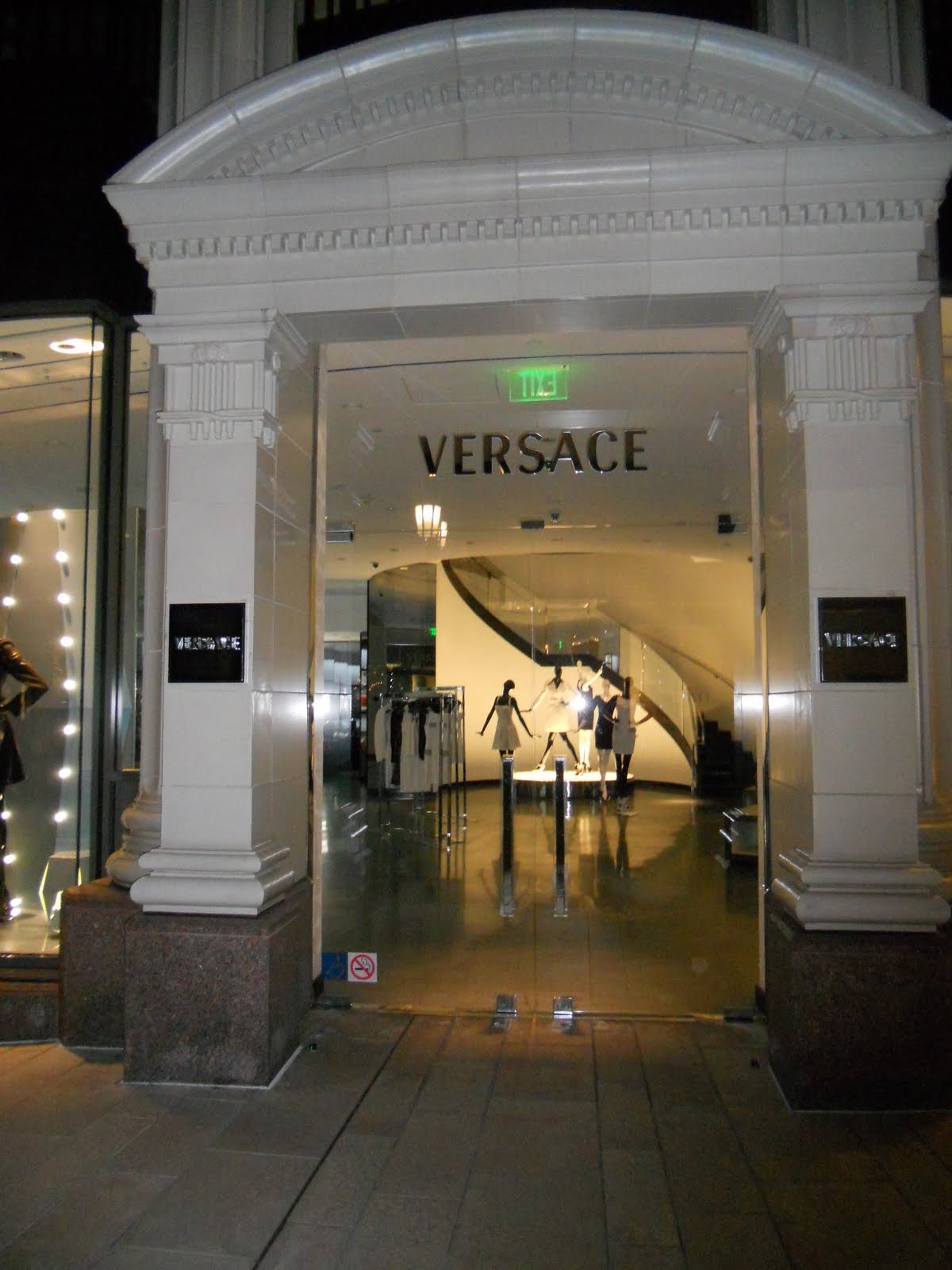


And just to keep this trademark relevant, let's take a quick look at the kinds of registrations each of these famous brand names include:

1. Word Mark GIANNI VERSACE
Goods and Services IC 003. US 051. G & S: Cologne. FIRST USE: 19790710. FIRST USE IN COMMERCE: 19790710 Mark Drawing Code (1) TYPED DRAWING Serial Number 73276397 Filing Date September 2, 1980 Current Filing Basis 1A Original Filing Basis 1A Published for Opposition July 26, 1983 Registration Number 1254212 Registration Date October 18, 1983 Owner (REGISTRANT) Gianni Versace S.r.l. LTD LIAB CO ITALY Via Senato 29 Milano ITALY

2. V'E VERSACE (and design)

Goods and Services International Class (IC) 003. G & S: [ COSMETICS; NAMELY, NIGHT AND DAY CREAM; CLEANING PREPARATIONS FOR FACE AND BODY ]; BATH FOAM; [ SHAVING FOAM; AFTERSHAVE; FOUNDATION MAKEUP; NAIL POLISH ]; DEODORANTS FOR MEN AND WOMEN; [ PERFUMED, UNPERFUMED AND HYPOALLERGENIC TOILET ]; HAND AND [ BABY SOAP; HAIR SHAMPOO AND RINSES; HAIR SPRAY; TOOTHPASTE ]; AND FRAGRANCES; NAMELY, PERFUME, TOILET WATER, AND ESSENCES FOR MEN AND WOMEN Mark Drawing Code (5) WORDS, LETTERS, AND/OR NUMBERS IN STYLIZED FORM Serial Number 73830655 Filing Date October 11, 1989 Current Filing Basis 44E Original Filing Basis 44D Published for Opposition April 7, 1992 Registration Number 1697282 Registration Date

3. Word Mark VERSACE
Goods and Services IC 003. G & S: cosmetics, namely night and day cream, cleaning preparations for the face and body, bathfoam, shaving foam, after-shave, foundation makeup, nail polish, deodorants for men and women, perfumed, unperfumed (natural) and hypoallergenic perfumes, cologne, toilet water, bath oils, hand and baby soap, hair shampoo and rinses, hair spray, toothpaste, and fragrances, namely perfume, toilet water and essence oils for personal use for men and women. FIRST USE: 19940900. FIRST USE IN COMMERCE: 19940900
IC 018. G & S: leather or imitations of leather, namely animal skins and hides, handbags, wallets, luggage, attache cases, tote bags, briefcases, all purpose sport bags, travelling trunks and carry-on bags, shoulder bags, garment bags for travelling, keycases, umbrellas, parasols and walking sticks, whips, harnesses and saddlery. FIRST USE: 19940900. FIRST USE IN COMMERCE: 19940900

IC 025. G & S: clothing for men, women and children, namely belts, coats, raincoats, waistcoats, blouses and pullovers, jackets, trousers, skirts, dresses, suits, shirts and chemises, T-shirts, sweaters, underwear, socks and stockings, gloves, ties, scarves, hats and caps, boots, shoes and slippers. FIRST USE: 19940900. FIRST USE IN COMMERCE: 19940900

Mark Drawing Code (1) TYPED DRAWING Serial Number 74582355 Filing Date October 5, 1994 Current Filing Basis 1A Original Filing Basis 1B Published for Opposition July 16, 1996 Registration Number 2121984 Registration Date December 16, 1997

--

1. Word Mark PORSCHE DESIGN
Goods and Services IC 009. G & S: [ Protective Helmets and ] Sunglasses. FIRST USE: 19770000. FIRST USE IN COMMERCE: 19780000
IC 014. US 002 027 028 050. G & S: [ Model Cars Made of Precious Metals and Their Alloys, or Coated Therewith, and ] Watches. FIRST USE: 19740000. FIRST USE IN COMMERCE: 19760000

IC 018. G & S: Attache Cases. FIRST USE: 19790000. FIRST USE IN COMMERCE: 19790000

Mark Drawing Code (1) TYPED DRAWING Serial Number 73277585 Filing Date September 12, 1980 Current Filing Basis 1A Original Filing Basis 1A Published for Opposition June 12, 1984 Registration Number 1292660 Registration Date September 4, 1984 Owner (REGISTRANT) Dr. Ing, h.c.F. Porsche A.G. COMPANY FED REP GERMANY PORSCHEPLATZ 1 0435 STUTTGART=-ZUFFENHAUSEN FED REP GERMANY

2. Word Mark PORSCHE DESIGN
Goods and Services IC 003. G & S: Perfumery, essential oils, cosmetics and hair lotions Standard Characters Claimed Mark Drawing Code (4) STANDARD CHARACTER MARK Serial Number 78868834 Filing Date April 25, 2006 Current Filing Basis 44E Original Filing Basis 44E Published for Opposition October 17, 2006 Registration Number 3194184 Registration Date January 2, 2007

3. Word Mark PORSCHE DESIGN
Goods and Services IC 008. G & S: Cutlery
IC 009. G & S: Photographic, cinematographic, optical, measuring and checking apparatus, namely, anti-glare glasses, spectacles, spectacle cases, spectacle frames, spectacle glasses, eye-glass cases, contact lenses, containers for contact lenses, cases especially made for photographic apparatus and instruments, mileage recorders for vehicles, speed-checking apparatus for vehicles, namely, speedometers, navigation apparatus for vehicles, binoculars, telescopes, cinematographic cameras, photographic cameras, optical lanterns, optical lenses, editing appliances for cinematographic films, navigational instruments, optical glass, DVD-players, sunglasses, optical mirrors, goggles for sports, stands for photographic apparatus, tripods for cameras, video screens, camcorders, video recorders, conductivity meters, instruments for measuring distances, photographic exposure meters, optical readers, instruments for measuring length; equipment for underwater diving, namely, oxygen breathing units comprised of oxygen cylinders and frames; protective helmets

IC 011. G & S: Flashlights; lighting apparatus, namely, light bulbs, Lighting tubes, lamps, arc lamps, electric lamps, light bulbs for directional signals for vehicles, lamps for directional signals of automobiles, safety lamps, diving lights, ultraviolet ray lamps, lamp chimneys, lamp shades, lamp shade holders, lanterns for lighting, bicycle lights, lights for vehicles, lights for automobiles, cycle lights, luminous tubes for lighting, electric discharge tubes for lighting

IC 012. G & S: Hydroplanes; motor launches and inflatable boats; go-karts; children's vehicles, namely, tricycles, push chairs, tilting-carts; two-wheeled vehicles, namely, bicycles, mopeds, motor cycles; safety seats for children for use in motor cars; steering wheels for sports cars; sailboards

IC 014. G & S: Watches and other instruments indicating time, namely, chronometrical instruments, chronographs, chronometers, clocks, control clocks, sundials; objects made of precious metals and their alloys, namely, miniature cars in the nature of brooches in the shape of a miniature car; jewelry; ornaments or handicraft objects made of precious metals and their alloys, also plated therewith, namely, ornamental pins, badges, amulets, bracelets, watch bands, threads, figurines, necklaces, boxes, chains, watch chains, cufflinks, tie clips, tie pins, cloisonne jewelry, pins, earrings, rings, key rings, jewelry cases, pasty jewelry, clock cases, watch cases; desk accessories, namely, a clock combined with a calendar

IC 016. G & S: Stationery articles, namely, stationery paper, paper weights, paper sheets, pencil holders, pencil leads, pencil sharpeners, pencil sharpening machines, pads, booklets in the field of automobiles, letter trays, office clips, namely, binder clips, paperclips, pen holders, pen clips, pen cases, pens, ball pens, pencils, pen nibs, pen nibs of gold, steel pens, pen wipers, fountain pens, stapling presses, calendars, index cards, announcement cards, correcting fluids, correcting ink, office perforators, pencil lead holders, erasers, pen cases, ink stands, writing instruments, wristbands for the retention of writing instruments, writing books, drawing books, writing cases, namely, pen and pencil cases, writing materials, namely, mechanical pencils, pencils, ink pens, drawing pads, stamps; printing type in the nature of numerals and letters; drawing apparatus, namely, pencils, crayons, pens, fountain pens, pastels, ink sticks; desk accessories, namely, a calendar combined with a clock

IC 018. G & S: Goods made of leather or of imitation leather, namely, wallets, purses, briefcases, bags, trimmings of leather for furniture, attache cases, key cases, bands of leather, valises, suitcase handles, handbags, card cases, sling bags for carrying infants, garment bags for travel, vanity cases sold empty, straps of leather, carrying cases for sheet music, furniture coverings of leather, traveling bags, bags for climbers, beach bags, bags for campers, school bags, shoulder belts, parasols, haversacks, packaging bags, tool bags, shopping bags, game bags, wheeled shopping bags, bags for sports; suitcases and trunks; suitcases and trunks of synthetic material or of metal; umbrellas, saddlery articles, namely, saddlery, pads for horse saddles, whips, harness; backpacks

IC 020. G & S: Furniture

IC 022. G & S: Tents, bivouac bags

IC 025. G & S: Clothing, namely, suits, belts, gloves, scarves, ties, jackets, shirts, tops, Bermuda shorts, bike leather jackets, blousons, coats, down jackets, polos, blazers, long sleeve shirts, pullovers, pants, trousers, t-shirts, sweaters, sweat-shirts, rain jackets, rain pants, wind pants, wind shirts, wind sweaters, socks, caps, hats, hat covers, golf bucket hats, golf caps, golf sweaters, golf rain jackets, golf rain pants, golf wind sweaters, running tights, training shorts, tennis pants, layettes, bathing suits, bathing trunks, bath robes, bathing caps, bandanas, berets, motorists' clothing, namely, jackets, pants, gloves; paper clothing, namely, paper hats for use as clothing items; boas, teddies, brassieres, bodices, chasubles, frocks, mittens, money belts, clothing for gymnastics, namely, leotards; jumpers, slips, detachable collars, shirt fronts, suspenders, paper hats, jerseys, stuff jackets, skullcaps, hoods, neckties, ascots, cloth bibs, clothing of leather, namely, jackets, pants, coats, gloves; clothing of imitations of leather, namely, jackets, pants, coats, gloves; underwear, sweat-absorbent underclothing, cuffs, pelisses, dressing gowns, muffs, outer clothing, namely, jackets, coats, capes; ear muffs, jump suits, furs, namely, fur coats, fur muffs; petticoats, parkers, pajamas, cyclists' clothing, namely, shorts, windbreakers, tights, jerseys; waterproof clothing, namely, jackets, rain boots; skirts, saris, collar protectors, sashes for wear, breeches for wear, headbands, shawls, beach clothes, namely, bathing suits, sandals, bikinis; garters, stockings, sweat-absorbent stockings, stocking suspenders, tights, knitwear, namely, sweaters, scarves; singlets, uniforms, wet suits, waistcoats; boots; shoes; slippers

IC 028. G & S: Games, namely, building games, board games, arcade games, parlor games, card games; toys, namely, building blocks, dolls, slides, scooters, rocking horses, teddy bears, push toys, stuffed toys, toy balloons; gymnastic and sporting equipment and articles, namely, gymnastic parallel bars, lines for fishing, fishing rods, balls for games, baseball gloves, bob-sleighs, body boards, body building apparatus, boxing gloves, stationary exercise bicycles, golf gloves, golf clubs, golf bags, fencing gauntlets, batting gloves, inline roller skates, roller skates, rackets, sleighs for recreational purposes, skateboards, bags especially designed for skis and surfboards, sole coverings for skis, ski-bindings, skis, edges of skis, snowboards, surf skis, surfboards, tennis ball throwing apparatus, table for table-tennis, tables for indoor football, springboards, wax for skis; toy miniature cars made of common metals and of synthetic material; sailboards

IC 034. G & S: Smokers' articles, namely, ashtrays, cigarette holders and cigarette cases not of precious metal or plated therewith; cigar and cigarette lighters; smoking pipes; snuff boxes

Mark Drawing Code (5) WORDS, LETTERS, AND/OR NUMBERS IN STYLIZED FORM Serial Number 79041669 Filing Date April 4, 2007 Current Filing Basis 66A Original Filing Basis 66A Published for Opposition March 24, 2009 Registration Number 3635423 International Registration Number 0456717 Registration Date June 9, 2009

---

1. Word Mark TIFFANY
Goods and Services IC 014. G & S: Watches and Clocks. FIRST USE: 18680000. FIRST USE IN COMMERCE: 18680000 Mark Drawing Code (5) WORDS, LETTERS, AND/OR NUMBERS IN STYLIZED FORM Serial Number 71126976 Filing Date January 9, 1920 Current Filing Basis 1A Original Filing Basis 1A Registration Number 0132262 Registration Date June 15, 1920 Owner (REGISTRANT) Tiffany & Company CORPORATION NEW YORK New York NEW YORK
(LAST LISTED OWNER) TIFFANY (NJ) INC. CORPORATION BY ASSIGNMENT NEW JERSEY 15 SYLVAN WAY PARSIPPANY NEW JERSEY 07054

2. Word Mark TIFFANY
Goods and Services IC 009 016 028. G & S: Printed Books, Visiting-Cards, Announcements, Invitations, Menus, Greeting-Cards, Certificates, Completely Printed or Engraved [ Dance-Orders and ] Diplomas, Labels Upon which Book-Plates Have Been Printed or Engraved, Programs, and Calendars. FIRST USE: 18920000. FIRST USE IN COMMERCE: 18920000 Mark Drawing Code (5) WORDS, LETTERS, AND/OR NUMBERS IN STYLIZED FORM Serial Number 71128252 Filing Date February 10, 1920 Current Filing Basis 1A Original Filing Basis 1A Registration Number 0140996 Registration Date March 29, 1921 Owner (REGISTRANT) Tiffany & Company CORPORATION NEW YORK FIFTH AVENUE AND 37TH STREET MANHATTAN NEW YORK
(LAST LISTED OWNER) TIFFANY (NJ) LLC CORPORATION DELAWARE 15 SYLVAN WAY PARSIPPANY NEW JERSEY 07054

3. Word Mark TIFFANY & CO.
Goods and Services IC 018. G & S: wallets, tote bags, handbags and business card cases. FIRST USE: 20080800. FIRST USE IN COMMERCE: 20080800 Standard Characters Claimed Mark Drawing Code (4) STANDARD CHARACTER MARK Trademark Search Facility Classification Code NOTATION-SYMBOLS Notation Symbols such as Non-Latin characters,punctuation and mathematical signs,zodiac signs,prescription marks Serial Number 77557869 Filing Date August 28, 2008 Current Filing Basis 1A Original Filing Basis 1A Published for Opposition May 26, 2009 Registration Number 3665959 Registration Date August 11, 2009 Owner (REGISTRANT) Tiffany (NJ) LLC LIMITED LIABILITY COMPANY DELAWARE 15 Sylvan Way Parsippany NEW JERSEY 07054

4. Word Mark TIFFANY TESORO
Translations The English translation of the word "TESORO" in the mark is "TREASURE". Goods and Services IC 014. G & S: Watches. FIRST USE: 20090916. FIRST USE IN COMMERCE: 20090916 Standard Characters Claimed Mark Drawing Code (4) STANDARD CHARACTER MARK Serial Number 77907378 Filing Date January 7, 2010 Current Filing Basis 1A Original Filing Basis 1A Published for Opposition June 8, 2010 Registration Number 3837308 Registration Date August 24, 2010 Owner (REGISTRANT) Tiffany (NJ) LLC LIMITED LIABILITY COMPANY DELAWARE 15 Sylvan Way Parsippany NEW JERSEY 07054

*** *** ***

That concludes this particular blog post. We hope you have found these photos and list of registrations to be useful and informative.

Best wishes,

William E. Maguire, Esq.
Los Angeles, Calif. USA
www.TrademarkEsq.com
Trademark • Copyright • Licensing

Wednesday, January 05, 2011

Signs Of The Times: Trademarks and Servicemarks

Just this morning on the way to work I crossed paths with two marks, or maybe it was just one. You decide.

In the photo below, a BUD LIGHT truck was just pulling up to a retail account while in the background is the large billboard sign advertising the current hit film in theatres nationwide, TRUE GRIT.


BUD LIGHT is certainly a famous trademark
owned by Anheuser Busch that is heavily advertised in the media, including but not limited to, the web, tv, print, etc. A peek at the TESS trademark database at www.uspto.gov reveals a bunch of BUD LIGHT trademark registrations, including but not limited to:

1. Word Mark BUD LIGHT Goods and Services IC 032. US 048. G & S: Beer. FIRST USE: 19820401. USED IN ANOTHER FORM as to "Bud" Apr. 1, 1939. FIRST USE IN COMMERCE: 19820401 Mark Drawing Code (1) TYPED DRAWING Serial Number 73386660 Filing Date September 20, 1982 Current Filing Basis 1A Original Filing Basis 1A Published for Opposition September 27, 1983 Registration Number 1261873 Registration Date December 20, 1983 Owner (REGISTRANT) Anheuser-Busch, Incorporated CORPORATION MISSOURI One Busch Pl. St. Louis MISSOURI 63118

2. Word Mark BUD LIGHT Goods and Services IC 025. US 039. G & S: CLOTHING, NAMELY CAPS, HATS, VISORS, T-SHIRTS, SHIRTS, SHORTS, JACKETS, [ VESTS, BELTS, ] SOCKS, SWEATSHIRTS, SUSPENDERS, SCARVES, WIND-RESISTANT JACKETS, SWEATERS, [ APRONS ] AND WARM-UP SUITS. FIRST USE: 19820000. FIRST USE IN COMMERCE: 19820000 Mark Drawing Code (1) TYPED DRAWING Serial Number 73678356 Filing Date August 14, 1987 Current Filing Basis 1A Original Filing Basis 1A Published for Opposition January 26, 1988 Registration Number 1485363 Registration Date April 19, 1988 Owner (REGISTRANT) ANHEUSER-BUSCH, INCORPORATED CORPORATION MISSOURI ONE BUSCH PLACE ST. LOUIS MISSOURI 63118

3. Word Mark BUD LIGHT

Goods and Services IC 025. US 022 039. G & S: CLOTHING - NAMELY,
[ HATS, JACKETS, SCARVES, SHORTS, ] SHIRTS [ , SWEATERS, VISORS ]. FIRST USE: 19820000. FIRST USE IN COMMERCE: 19820000 Mark Drawing Code (3) DESIGN PLUS WORDS, LETTERS, AND/OR NUMBERS Design Search Code 26.11.01 - Rectangles as carriers or rectangles as single or multiple line borders Serial Number 73694950 Filing Date November 13, 1987 Current Filing Basis 1A Original Filing Basis 1A Published for Opposition April 19, 1988 Registration Number 1495924 Registration Date July 12, 1988 Owner (REGISTRANT) ANHEUSER-BUSCH, INCORPORATED CORPORATION MISSOURI ONE BUSCH PLACE ST. LOUIS MISSOURI 63118

4. Word Mark BUD LIGHT Goods and Services IC 021. US 002. G & S: serving trays not of precious metal, portable coolers, bottle openers, drinking vessels and thermal insulated containers for beverages. FIRST USE: 19840000. FIRST USE IN COMMERCE: 19840000 Mark Drawing Code (1) TYPED DRAWING Serial Number 74174273 Filing Date June 10, 1991 Current Filing Basis 1A Original Filing Basis 1A Published for Opposition August 25, 1992 Registration Number 1733107 Registration Date November 17, 1992 Owner (REGISTRANT) Anheuser-Busch, Incorporated CORPORATION MISSOURI One Busch Place St. Louis MISSOURI 63118


TRUE GRIT is a feature film based on a book.
It is also a so called re-make of a film of the same name that starred John Wayne for which he was awarded an Oscar for Best Actor. Is TRUE GRIT a trademark, however? Or service mark?

The uspto.gov trademark database reveals no registrations for the film title, which is consistent with the USPTO practice of not permitting registrations for single film titles. A series of films, however, are capable of being registered as a U.S. Federal Service mark in Intl. Class #41 for a series of films. Examples of films that are capable of being registered as entertainment service marks for a series of films include: LETHAL WEAPON, DIE HARD, and SCARY MOVIE.

As an aside, there are several third party trademarks that are registered for TRUE GRIT that have nothing to do with the film. For example:

1. Word Mark TRUE GRIT Goods and Services IC 025. US 039. G & S: clothing, headwear and footwear; namely, blouses, coveralls, T-shirts, shirts (knit), sportshirts, sweaters, sweatshirts, dresses, jeans, pants, shorts, skirts, coats, jackets, swimwear, hats, shoes, and sandals. FIRST USE: 19910730. FIRST USE IN COMMERCE: 19910904 Mark Drawing Code (1) TYPED DRAWING Serial Number 74321438 Filing Date October 9, 1992 Current Filing Basis 1A Original Filing Basis 1B Published for Opposition December 21, 1993 Change In Registration CHANGE IN REGISTRATION HAS OCCURRED Registration Number 1890573 Registration Date April 18, 1995 Owner (REGISTRANT) Calor Apparel Group International Corp. CORPORATION CALIFORNIA 1008-A BRIOSO DRIVE COSTA MESA CALIFORNIA 92627 (LAST LISTED OWNER) DRAGON NINE APPAREL, INC. CORPORATION DELAWARE 431 NORTH OAK STREET INGLEWOOD CALIFORNIA 90302

2. Word Mark TRUE GRIT CAFE Goods and Services IC 043. US 100 101. G & S: Restaurant. FIRST USE: 19851201. FIRST USE IN COMMERCE: 19851201 Standard Characters Claimed Mark Drawing Code (4) STANDARD CHARACTER MARK Serial Number 77470667 Filing Date May 9, 2008 Current Filing Basis 1A Original Filing Basis 1A Published for Opposition October 14, 2008 Registration Number 3553610 Registration Date December 30, 2008 Owner (REGISTRANT) Tuttle, Tammee INDIVIDUAL UNITED STATES PO BOX 2003 Ridgway COLORADO 81432

note: The "TRUE GRIT CAFE" needs to be careful not to try to create the impression that it is associated or sponsored by the Estate of John Wayne and not to use John Wayne's likeness. The same caution should extend to the current film. Otherwise, this cafe owner runs the risk of running afoul of the Federal Lanham Act Sec. 43 which proscribes unfair competition. State laws with respect to Right of Publicity could also come into play.

Word Mark TRUE GRIT Goods and Services IC 033. US 047 049. G & S: Wine. FIRST USE: 20060828. FIRST USE IN COMMERCE: 20060828 Standard Characters Claimed Mark Drawing Code (4) STANDARD CHARACTER MARK Serial Number 78597056 Filing Date March 29, 2005 Current Filing Basis 1A Original Filing Basis 1B Published for Opposition December 27, 2005 Registration Number 3178341 Registration Date November 28, 2006 Owner (REGISTRANT) Mendocino Wine Group LTD LIAB CO CALIFORNIA 501 Parducci Rd. Ukiah CALIFORNIA 95482

---


While it may be debatable whether or not it takes true grit to drink BUD LIGHT®, one thing is certain: Trademarks should be registered and defended. The Anheuser-Busch strategy is obviously one of strong and aggressive registration.

*** *** ***

Disclaimer: No claim of ownership is made herein with respect to the trademarks discussed herein. The purpose of this article is to highlight the importance of registering one's trademarks in order to take advantage of the procedural and substantive benefits of doing so.

Friday, December 24, 2010

Merry Christmas and Happy Holidays!

From all of us to all of you, we wish you a Merry Christmas and Happy Holidays!


(Photo show Wilshire Blvd. during a light rain shower in Beverly Hills, Calif.
on Friday evening, Dec. 17, 2010. Photo by & Copyright Will Maguire 2010. Used here with permission).


We also welcome you to revisit our Dec. 2006 blog post entitled,

'TIS THE SEASON

which features some brief remarks about winter and holiday related trademarks.

http://trademarkesq.blogspot.com/2006/12/tis-season.html

Happy New Year !


William E. Maguire
LAW OFFICES OF WILLIAM E. MAGUIRE
http://www.TrademarkEsq.com
Los Angeles, California

*** *** ***

Monday, December 06, 2010

Licensing In The Buff

Licensing In The Buff, aka, "Naked Licensing"as an affirmative defense was just clarified by the 9th U.S. Circuit Court of Appeal in FreecycleSunnyvale v. The Freecycle Network (9th Cir., Nov. 24, 2010, No. 08-16382).

As stated by the 9th Circuit:
“FreecycleSunnyvale is a member group of The Freecycle Network, an organization devoted to facilitating the recycling of goods. FreecycleSunnyvale filed a declaratory action against The Freecycle Network arising from a trademark licensing dispute, alleging non-infringement of The Freecycle Network’s trademarks and tortious interference with FreecycleSunnyvale’s business relations. FreecycleSunnyvale moved for partial summary judgment on the issue of whether its naked licensing defense to trademark infringement allowed it to avoid a finding of infringement as a matter of law. The Freecycle Network argued that it had established adequate quality control standards over its licensees’ services and use of the trademarks to avoid a finding of naked licensing and abandonment of its trademarks. The district court granted summary judgment to FreecycleSunnyvale.” On appeal, The Freecycle Network (hereinafter, TFN) asserted that it did exercise adequate and reasonable control over its licensee.

"Naked Licensing" defined:


“Naked Licensing” occurs when the licensor “fails to exercise adequate quality control over the licensee.” Barcamerica at 596. Citing J. Thomas McCarthy, the court also stated, “Naked licensing may result in the trademark’s ceasing to function as a symbol of quality and a controlled source (3 J. Thomas McCarthy, McCarthy on Trademarks and Unfair Competition §17:12n.2 (4th ed. 2010)).

The First Rule:

Generally speaking, the trademark owner who licenses the right to use its trademarks to another must exercise control with respect to the quality of their trademark’s on the licensed goods or services. “It is well-established ‘[a] trademark owner may grant a license and remain protected provided quality control of the goods and services sold under the trademark by the licensee is maintained.’” Barcamerica Int’l USA Trust v. Tyfield Importers, Inc., 289 F. 3d 589 (9th Cir. 2002).

The Analysis:

The 9th Circuit’s analysis in deciding summary judgment on a claim of naked licensing includes:

1. Does the license contain an “express contractual right to inspect and supervise the licensee’s operations? In this case, TRN did not have an express license agreement and without such TRN did not have the express right to inspect and supervise FS.

2. In the absence of an express contractual right to quality control, did the licensor nevertheless demonstrate actual control through inspection or supervision?

3. Even if licensor did not itself exercise actual control, was there, in fact, “a close working relationship” between licensor and licensee “to establish adequate quality control in the absence of a formal agreement.”? Barcamerica, 289 F. ed at 597.)

The 9th Circuit, in the end, ruled “that TFN (1) did not retain express contractual control over FreecycleSunnyvale’s quality control measures, (2) did not have actual control over FreecycleSunnyvale’s quality control measures, and (3) was unreasonable in relying on FreecycleSunnyvale’s quality control measures. Therefore, we conclude that TFN engaged in naked licensing and consequently abandoned the trademarks. The district court’s grant of summary judgment in favor of FreecycleSunnyvale and against TFN is AFFIRMED.”

The Take-Aways:

1. “Put It In Writing.” After all, as the saying goes (reputedly by the legendary Studio mogul, Jack Warner), “an oral contract is not worth the paper it is written on. Include express rights of the licensor to inspect or supervise the license. There should be quality control standards that are enforced by the licensor.

2. “Stay Busy”, e.g., paper the file. Confirm phone calls or conversations in writing or via email. Keep a “Quality Control” file and maintain it.

3. “Stay Involved”, e.g., do not rely solely on your licensee’s own quality control measures.

Conclusion:


A finding and ruling of the existence of a “naked license” is just the kind of double whammy the licensor definitely wants to avoid. Not only is your license unenforceable, but your trademarks are declared “abandoned”. Pay attention to your license and licensee and you too may live to enjoy the sweet smell of success. It sure beats getting caught with your pants down running naked and without a license... and no mark to show for it.

*** *** ***

Thursday, September 23, 2010

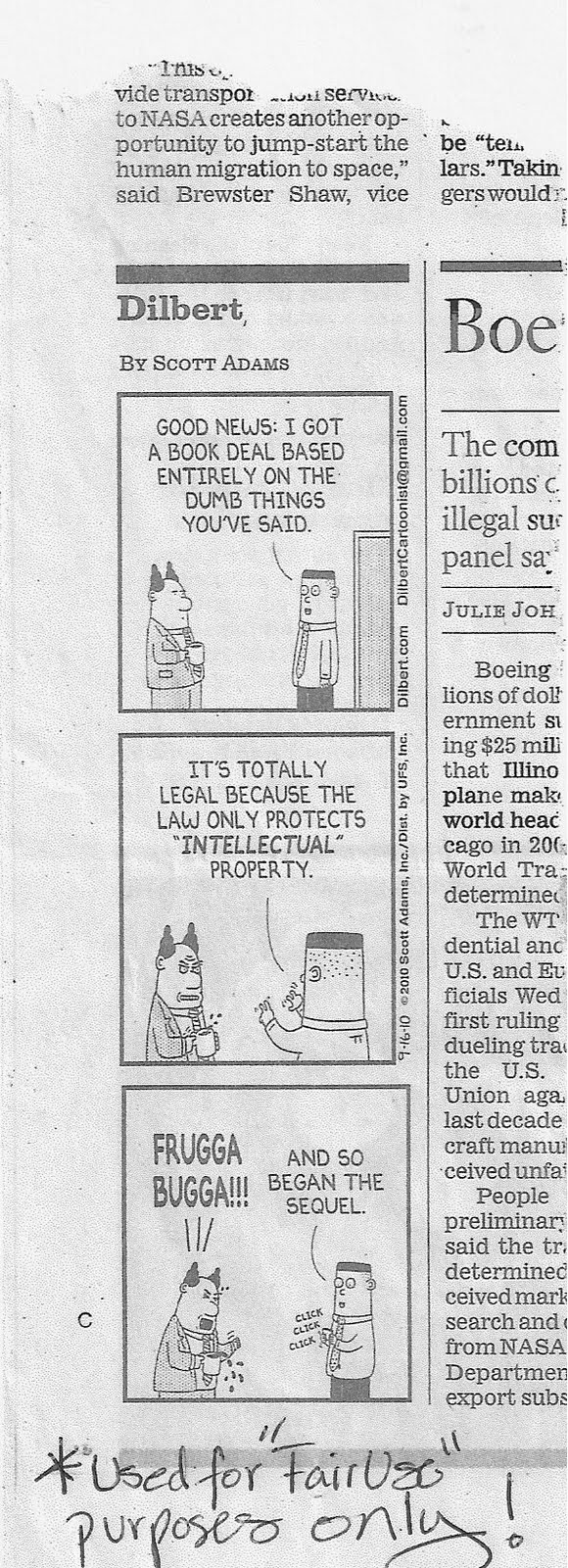
"Intellectual Property" According to DILBERT® - The Sequel

This past week the L.A. Times featured a particularly funny episode in the 'corporate work world' based DILBERT® syndicated cartoon strip. *** See for yourself.


(Please Note: This comic strip has been reproduced for fair use purposes in connection with a corresponding blog post on the topic of Intellectual Property. The DILBERT® comic strip is not being used here as a trademark.)

The 'double entendre' in the second panel aside, this amusing storyline raises several intellectual property related issues, including but not limited to:

1. What is "intellectual property"?

2. Can someone really repeat/reproduce the verbal expression of another without their permission?

3. Can the name and likeness of the boss, who said the 'dumb things', be used by his employee who plans on publishing a book based entirely on the dumb things his boss has said?

We plan on answering these questions in our next posting so please stay tuned. Thank you for your interest.

*** This cartoon has been reproduced pursuant to the Fair Use principles of the U.S. Copyright Act for the purpose of this educational and scholarly article. DILBERT is the property of and Copyright Scott Adams, Inc. 2010. www.Dilbert.com. DILBERT® is the trademark of Scott Adams, Inc.

For more information on the DILBERT cartoon strip and series, check out the Wikipedia article online at: http://en.wikipedia.org/wiki/Dilbert

---


Until next time...


William E. Maguire, Esq.
LAW OFFICES OF WILLIAM E. MAGUIRE
Los Angeles, California
www.TrademarkEsq.com

DISCLAIMER:
William E. Maguire and TrademarkEsq.com are not affiliated with DILBERT® or Scott Adams, Inc.

Friday, September 17, 2010

A Primer on the Selection And Clearance of Trademarks

*** As Published in the L.A. Daily Journal ***


AUGUST 5, 2010 | PERSPECTIVE

A Primer on the Selection And Clearance of Trademarks

By William E. Maguire

Surfboards, swim fins, wetsuits, t-shirts, swimsuits, sunglasses, sunscreen, bottled water, sandals, umbrellas, towels, volleyballs, ice chests - sounds like another summer day at the beach! To the savvy, business entrepreneur, however, these beach accessories are the breeding ground for commercial exploitation. Not far behind in this consumer petrie dish of sand and capitalism is the need to select a trademark by which the item exploited will be known, e.g., Hobie® surfboards, O'Neill® wetsuits, Oakley® sunglasses, Tommy Bahama® beach towels, hats, shirts and shorts, and Coppertone® sunscreen and tanning lotions. A trademark is defined as any word, symbol, slogan, or device (such as a design), or a combination of them, used by a manufacturer or merchant to identify his goods or services and to distinguish them from those manufactured, sold or serviced by others. Coppertone® and Speedo® are excellent examples of 'word' marks. "Tan Don't Burn" is an example of a 'slogan' mark. A logo or design such as the famous Coppertone girl and the dog is an example of a 'design' mark. An example of a service mark is ESPN® for the "entertainment services, reporting and sports programming services rendered through the medium of television." Such a service mark can also be exploited and serve as a trademark (i.e., for clothes (shirts, hats, sweaters; prerecorded dvd's and cd's; beach bags, beach towels, etc.). In the U.S., trademark rights are acquired through use (e.g., by selling or transporting your product in commerce with the mark attached or on a label). In addition, under certain circumstances "color" can be a trademark. Examples outside the surf/beach industry are the color "pink" for fiberglass insulation and "green" for dry cleaning pads.

The selection of a trademark is the first step that a merchant undertakes to create an identity. The clearance of a trademark is the process of determining whether or not the trademark is available for use. Ignoring this vital step can lead to a multitude of problems and expense. A two-step process is suggested: First, conduct an online computer trademark search of the mark. This online search identifies the goods sought to be used or sold as trademarks and categorizes by classification. In the United States, the federal government has adopted the international classification system. Toys, sporting goods, volleyballs swim fins, bodyboards, and surfboards are in Class #28. Swimsuits and beach apparel and clothing are in Class #25. Backpacks, beach bags and gear bags are in Class #18. Posters, magazines, books, trading cards, and other printed matter and publications are in Class #16. DVD's, compact discs, video game software (including downloadable software over a global computer network), surfing and skateboard helmets are in Class #9. Therefore, if you are planning to sell surfboards, apparel and gear bags, then you will want to conduct an online search of Classes # 28, 25 and 18. The online search is often called a "knock-out" search because it is a quick and relatively inexpensive way to determine if the mark is taken. These searches are available at www.uspto.gov, or can be performed by commercial search firms and law firms.

If your mark appears free of conflicts after conducting an online search, the next step is the full search, which is obtained from commercial search firms. The full search will scour the federal database of trademarks at the Patent and Trademark Office, state trademark registrations, common law sources such as phone directories, the Internet and Dun & Bradstreet listings, plus Internet domain name registrations. If your mark still appears clear of conflicts after a full search, then you can be fairly certain that you can adopt and start using your mark. These searches are not guarantees of the absence of conflicting marks, but they do allow a merchant to make an informed decision in the clearance of a trademark.

To obtain maximum protection, it is best to register your trademark or service mark. In the U.S., your greatest rights can be obtained with a federal trademark registration.
If you are only conducting business within one state, it is possible to register your mark with the appropriate Secretary of State. However, if you intend to do business across state lines or in foreign commerce, then the prudent thing to do is to file for a federal trademark application with the U.S. Patent and Trademark Office located in Alexandria, Va.

An application for registration of a trademark must be filed in the name of the owner of the mark. The on-line application is both recommended and preferred by the U.S. Patent and Trademark Office at www.uspto.gov. In fact, an application filed via mail is more costly than filing on-line. The applicant must submit: an application; a drawing of the mark; and the required filing fee (which is $325 per mark per class at this time for an application filed on-line, or $375 if filed the old fashioned way). The applicant will also incur attorney fees, typically a fixed fee, should an attorney be hired to file the application. After the mark is registered in the U.S., it is important to give notice of this fact by placing the registered trademark symbol, "®," adjacent to the mark. Prior to registration, it is also advisable to use the symbols, "TM" (for trademarks) and "SM" (for service marks).

The chief advantages of a federal registration include:
Constructive notice nationwide of the registrant's claim to ownership of the mark. This eliminates the good faith defense of an infringer who claims to have lacked actual knowledge of the registered mark. Registration is also evidence of the validity of the registration; the registrant's ownership of the mark; and the registrant's exclusive right to use the mark in commerce in connection with the goods or services. In addition, registration entitles the registrant to file a lawsuit for infringement of the mark in Federal Court; prevent importation of goods bearing an infringing mark; and use the registration as a basis for registering the same mark in certain foreign countries.

Trademark registrations are valid for 10 years subject to certain use and filing requirements, and are renewable every 10 years, also subject to continued use and renewal filing requirements.

If your product is distributed internationally, then you must, by and large, register your mark in each country where you plan to do business or are doing business.
Is this expensive? Yes! On the other hand, the alternative is the potential loss of the ability to sell your product in those countries where a third party has filed a prior application for your mark. Therefore, foreign trademark protection is typically obtained on a country-by-country basis. Unlike the U.S., however, trademark rights in many foreign countries are obtained by registration rather than use. This further necessitates the importance of filing for marks in foreign countries as soon as possible.

One notable alternative to the typical practice of registering trademarks on a country-by-country basis is the European Community Trade Mark Application
, which has been available since Jan. 1, 1996. By obtaining a community wide trademark registration, an owner of a U.S. registered trademark, for example, can potentially save both time and money otherwise invested in registering a mark in each separate European country and can thus hopefully attain maximum protection for its trademarks in overseas markets at a minimum of cost.

Whether you are selling products or services, it is very important to be aware of your trademark and/or service mark and their value. In a competitive business environment, the potential for economic loss is tremendous if trademark rights are not acquired, evaluated, protected and maximized.

William E. Maguire is a sole practitioner in Los Angeles and concentrates on trademarks, copyrights and licensing. He can be reached at maguire@artnet.net, or through www.tmesq.com.

Friday, July 30, 2010

SUMMER 2010: AT THE BEACH


SUMMER 2010: AT THE BEACH


A Primer on the Selection and Clearance of Trademarks

© Copyright 2010, William E. Maguire. All Rights Reserved.


INTRODUCTION:

Surfboards, swim fins, wetsuits, t-shirts, swimsuits, sunglasses, sunscreen, bottled water, sandals, umbrellas, towels, volleyballs, ice chests........ sounds like another summer day at the beach! To the savvy, business entrepreneur, however, these beach accessories/necessities are the breeding ground for commercial exploitation. Not far behind in this consumer petrie dish of sand and capitalism is the need to select a trademark by which the item exploited will be known, e.g., HOBIE® surfboards, O'NEILL® wetsuits, OAKLEY® sunglasses, TOMMY BAHAMA® beach towels, hats, shirts and shorts, VESTAL® wristwatches, MIKASA® volleyballs, and COPPERTONE® sunscreen and tanning lotions. This article will highlight some famous trademarks in the sun, sand & surf and will briefly address the legal and business issues with respect to the selection, clearance and registration of such trademarks.


TRADEMARKS DEFINED

A trademark (or mark) is defined as any word, symbol, slogan, or device (such as a design), or a combination of them, used by a manufacturer or merchant to identify his goods or services and to distinguish them from those manufactured, sold or serviced by others. COPPERTONE® and SPEEDO® are excellent examples of 'word' marks. "TAN DON'T BURN" is an example of a 'slogan' mark. A logo or design such as the famous COPPERTONE girl and the dog is an example of a 'design' mark. An example of a service mark is ESPN® for the "entertainment services, reporting and sports programming services rendered through the medium of television." Such a service mark as ESPN® can also be exploited and serve as a trademark (i.e., for clothes (shirts, hats, sweaters; prerecorded dvd's and cd's; beach bags, beach towels, etc.). In the U.S., trademark rights are acquired through use (e.g., by selling or transporting your product in commerce with the mark attached or on a label). In addition, under certain circumstances "color" can be a trademark. Examples outside the surf/beach industry are the color "pink" for fiberglass insulation and "green" for dry cleaning pads.


SELECTION AND CLEARANCE

The selection of a trademark is the first step that a merchant undertakes to create an identity for his/her surfboard or swimsuit, etc. The clearance of a trademark is the process of determining whether or not the trademark is available and is not being used by someone else as a trademark. This clearance process cannot be overemphasized in its importance. Ignoring this vital step can lead to a multitude of problems and expense. In the clearance of a trademark, a two-step process is suggested. The first step is to conduct an on-line computer trademark search of the mark. This on-line search is further clarified by identifying the goods sought to be used or sold as trademarks are categorized by classification. In the United States, the federal government has adopted the International Classification system. Toys, sporting goods, volleyballs swim fins, bodyboards, and surfboards are in Class #28. Swimsuits and beach apparel and clothing are in Class #25. Backpacks, beach bags and gear bags are in Class #18. Posters, magazines, books, trading cards, and other printed matter and publications are in Class #16. DVD's, compact discs, video game software (including downloadable software over a global computer network), surfing and skateboard helmets are in Class #9. Therefore, if you are planning to sell surfboards, apparel and gear bags, then you will want to conduct an on-line search of Classes # 28, 25 and 18. The on-line search is often called a "knock-out" search. This is because the on-line search is a quick and relatively inexpensive way to determine if the mark is already being used. These on-line searches are available on the internet, e.g., at www.uspto.gov, or can be performed by commercial search firms and law firms.

If your mark appears free of conflicts after conducting an on-line search, the next level of search is the full search, which is obtained from commercial search firms like THOMSON COMPUMARK and CT CORSEARCH. The full search will search the federal database of trademarks at the Patent and Trademark Office, State trademark registrations, common law sources such as phone directories, the internet and Dun & Bradstreet listings, plus internet domain name registrations. If your mark still appears clear of conflicts after a full search, then you can be fairly certain that you can adopt and start using your mark. CAVEAT: These searches are not guarantees of the absence of conflicting marks, but they do allow a merchant to make a more informed decision in the clearance of a trademark.


FEDERAL TRADEMARK REGISTRATION

To obtain maximum protection, it is best to register your trademark or service mark. In the U.S., your greatest rights can be obtained with a federal trademark registration. If you are only conducting business within one state, e.g., California, it is possible to register your mark with the California Secretary of State. However, if it is your intent to do business across state lines or in foreign commerce (or if you are already doing business across state lines or in foreign commerce), then the prudent thing to do is to file for a federal trademark application with the U.S. Patent and Trademark Office located in Alexandria, Virginia.

An application for registration of a trademark must be filed in the name of the owner of the mark. The on-line application is both recommended and preferred by the USPTO at www.uspto.gov. In fact, a written application filed via U.S. First Class Mail or the like, e.g., the old fashioned way, is more costly than filing on-line. The applicant must submit: (a) an application; (b) a drawing of the mark; (c) the required filing fee (which is $325 per mark per class at this time for an application filed on-line, or $375 if filed the old fashioned way). The applicant will also incur attorneys fees, typically a fixed fee, should an attorney be hired to file the application(s). After the mark is registered in the U.S., it is important to give notice of this fact by placing the registered trademark symbol, "®", adjacent to the mark. Prior to registration, it is also advisable to use the symbols, "TM" (for trademarks) and "SM" (for service marks).

The chief advantages of a federal registration include:


"Constructive Notice" nationwide of the registrant's claim to ownership of the mark. This basically eliminates the good faith defense of an infringer who claims to have lacked actual knowledge of the registered mark.

Registration is also evidence of (a) the validity of the registration; (b) the registrant's ownership of the mark; and (c) the registrant's exclusive right to use the mark in commerce in connection with the goods or services.

Registration also entitles the registrant to (a) file a lawsuit for infringement of the mark in Federal Court; (b) prevent importation of goods bearing an infringing mark; and (c) use the registration as a basis for registering the same mark in certain foreign countries.

Trademark registrations are valid for 10 years subject to certain use and filing requirements, and are renewable every 10 years, also subject to continued use and renewal filing requirements.


FOREIGN TRADEMARK REGISTRATION


If your product is distributed internationally, then you must, by and large, register your mark(s) in each country where you plan to do business or are doing business. Is this expensive? Yes! On the other hand, the alternative is the potential loss of the ability to sell your product in those countries where a third party has filed a prior application for your mark(s). Therefore, foreign trademark protection is typically obtained on a country-by-country basis. Unlike the U.S., however, trademark rights in many foreign countries are obtained by registration rather than use. This further necessitates the importance of filing for marks in foreign countries as soon as possible.

One notable alternative to the typical practice of registering trademarks on a country-by-country basis is the European Community Trade Mark Application which has been available since January 1, 1996. By obtaining a Community wide trademark registration, an owner of a U.S. registered trademark, for example, can potentially save both time and money otherwise invested in registering a mark in each separate European country and can thus hopefully attain maximum protection for its trademarks in overseas markets at a minimum of cost.

CONCLUSION

Whether you are selling products or services, it is very important to be aware of your trademark and/or service mark and their value. In a competitive business environment, the potential for economic loss is tremendous if trademark rights are not acquired, evaluated, protected and maximized. While this article does not portend to cover all the intricacies of trademark law, hopefully it has helped to shed some light on this area of the law which is of paramount importance to the business owner.

---

William E. Maguire is a sole practitioner in Los Angeles and concentrates on trademarks, copyrights and licensing. He can be reached at:
email: maguire@artnet.net
web: www.TrademarkEsq.com


***** ***** *****

Thursday, July 15, 2010

Fair Use: No Harm No Foul!

With apologies to Chick Hearn, when it comes to the fair use of someone else's trademark, the courts upon finding same, are in effect, stating, "No Harm No Foul!"

Additionally, there is (Statutory) Fair Use and then there's (Nominative) Fair Use. Confused? No worries, because...

Recently, the 9th Circuit U.S. Court of Appeals discussed "nominative fair use" in the matter of:

Toyota Motor Sales U.S. A. Inc. v. Tabari, No. 07-55344, July 8, 2010.

In an opinion written by Chief Judge Kozinski, the court reversed and remanded the District Court's finding of trademark infringement. In a stern and specific ruling, Judge Kozinski stated that on remand the District Court shall use "New Kids" likelihood of confusion test to ascertain a finding of fair use and that the Sleekcraft test for likelihood of confusion was not applicable where a defendant has made a showing of nominative fair use, as in this case. To quote the Court on this point, "When considering the scope and timing of any infringement on remand, the district court must eschew application of Sleekcraft and analyze the case solely under th rubric of nominative fair use.

note:
"Sleekcraft" refers to the ordinary test for likelihood of confusion in the 9th Circuit, as set forth in the case, AMF v. Sleekcraft Boats, 599 F.2d, 341, 348-49 (9th Cir. 1979).

To the facts of this case: The Defendant Tabari registered and was using the internet domain names: buyalexus.com and buyorleaselexus.com

The Tabaris were using the term Lexus to describe their business of brokering Lexus automobiles and this the Court held to be a fair use and therefore not infringing.

The "New Kids" test re nominative fair use is named after an earlier and precedential 9th Circuit case, namely, New Kids on the Block v. News Am. Publishing, Inc., 971 F.2d 302, 308 (1992). This New Kids case was later relied upon by the 9th Circuit in the 2002 case, Playboy Enterprises, Inc. v. Welles, 279 F.3d 796, 801. This test is described by the Court as follows:

"In cases where a nominative fair use defense is raised, we ask whether (1) the product was "readily identifiable" without use of the mark; (2) defendant used more of the mark than necessary; or (3) defendant falsely suggested he was sponsored or endorsed by the trademark holder... This test "evaluates the likelihood of confusion in nominative use cases."

Additionally, the court clearly indicated that as to the burden of proof with respect to this defense:

"A defendant seeking to assert nominative fair use as a defense need only show that it used the mark to refer to the trademarked good, as the Tabaris undoubtedly have here. The burden then reverts to the plaintiff to show a likelihood of confusion."

Conclusion: In this case, the 9th Circuit has made clear that the nominative fair use defense can apply to domain names that incorporate third party trademarks, just as the Playboy v. Welles case indicated that use of a mark in a website's metatags constituted nominative fair use.

*** *** ***

Respectfully submitted,

William E. Maguire, Esq.
LAW OFFICES OF WILLIAM E. MAGUIRE
Los Angeles, California

www.TrademarkEsq.com

***** ***** ***** ***** *****

Tuesday, June 29, 2010

Dilution by Blurring is Paved with Good Intentions

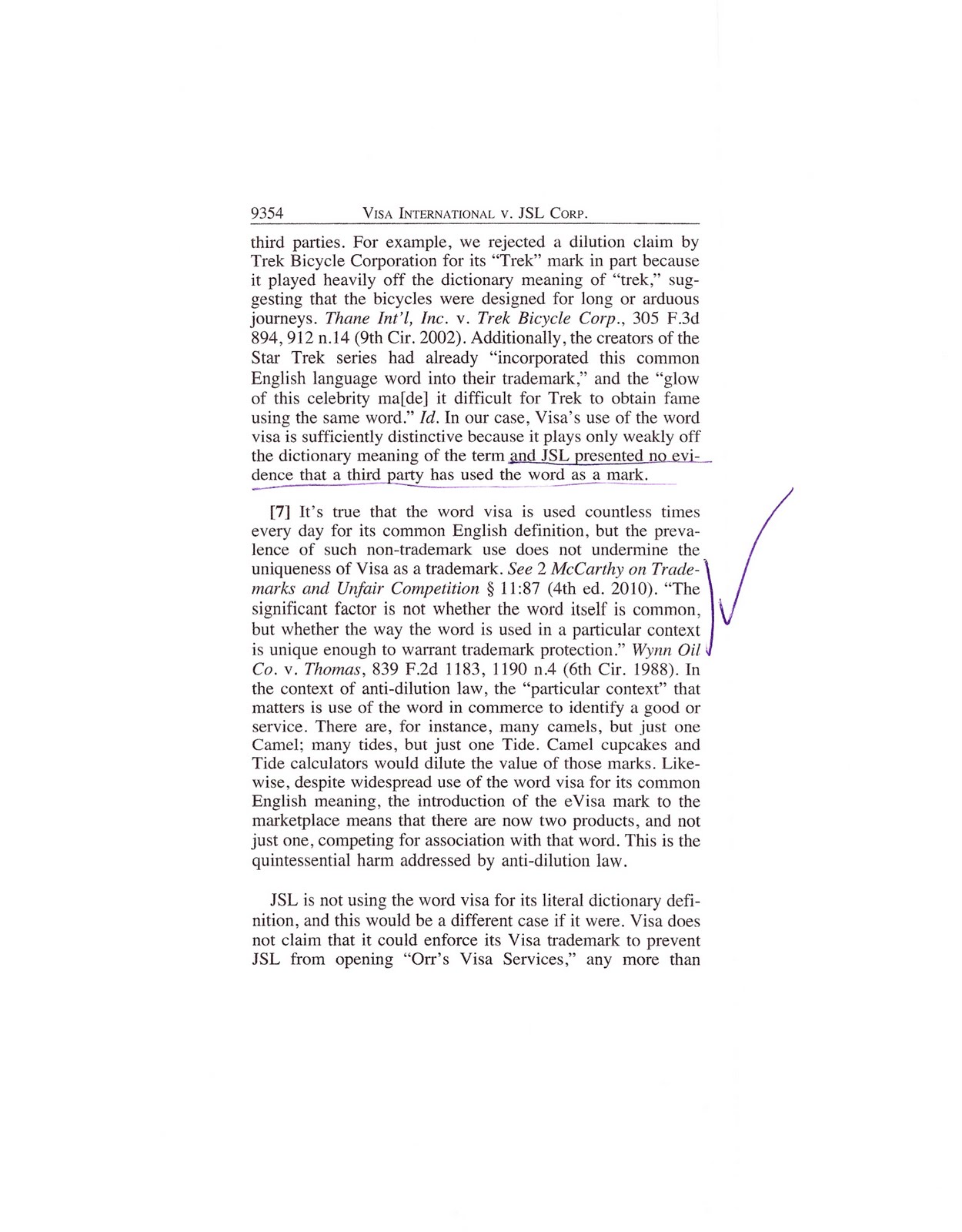
Shell espresso. Tide calculators. Camel cupcakes. These are just a few of the musings of Chief Judge Kozinski in the latest 9th Circuit ruling affirming the lower District Court's summary judgment finding of dilution by blurring (Visa vs. JSL, June 28, 2010; No. 08-15206; D.C. No. CV-01-00294-LRH/LRL).

For the reader's convenience, this Opinion is incorporated herein.

Talking Points or Take Aways:


1. Dilution isn't confusion.
2. Dilution occurs when consumers form new and different associations with the plaintiff's mark.
3. Use of an identical mark provides circumstantial evidence of dilution.
4. Establishing likelihood of dilution does not require expert testimony or market surveys.
5. Good intentions alone do not negate a showing of likelihood of dilution.

Comment: With apologies to John Milton, this case does indeed point out that the defendant's "good intentions", e.g., his claim that he had no intent to dilute the plaintiff's VISA mark, "alone do not negate a showing of likelihood of dilution."

Conclusion: Dilution by Blurring is paved with Good Intentions.

6. Non-trademark use of a common English word by third parties does not undermine the uniqueness of said common English word as a trademark by the trademark holder.

7. "But dilution always involves use of a mark by a defendant that is "different" from the plaintiff's use; the injury addressed by anti-dilution law in fact occurs when marks are placed in new and different contexts, thereby weakening the mark's ability to bring to mind the plaintiff's goods or services."


*** *** ***


Respectfully submitted,


William E. Maguire
LAW OFFICES OF WILLIAM E. MAGUIRE
Los Angeles, California
www.TrademarkEsq.com

*** *** *** *** ***

Thursday, June 17, 2010

"Trademarks In The Sun, Sand and Surf"


Summer 2010 is rapidly approaching with some schools already finished and others finishing up this friday. With the warm weather already here, the first official day of summer on Monday, June 21, 2010 will start out strong.

Plenty of trademarks will be out in force too from sunscreen, to hats, to bathing suits, to umbrellas, to surfboards, bodyboards, swim fins, goggles, beach towels, flip flops, t-shirts, sunglasses, etc. et al.


Can you think of some of the brands that come to mind. Coppertone, Oakley, Persol, Nike, Billabong, Quiksilver, Morey, Speedo, etc.

Each of these brands are protected by registered trademarks. If you are doing business and selling product, then you too need to think carefully about obtaining trademark registrations in the countries where you sell your goods.

If you would like to learn a bit more about the basics of registering your trademark, have a look at the following linked article:


AT THE BEACH: A Primer on the Selection and Clearance of Trademarks


http://www.trademarkesq.com/pages/article9.html


In the words of Coppertone, remember: "Tan, Don't Burn!"


William E. Maguire,
LAW OFFICES OF WILLIAM E. MAGUIRE
www.TrademarkEsq.com

*** *** *** *** ***

Tuesday, June 01, 2010

"It's DUNKIN' DONUTS in the USA"

Last month we wrote about DUNKIN' COFFEE in Spain. This month, having just returned from Boston, Mass. last week, we can accurately report that it is still, indeed, DUNKIN' DONUTS, here in the good old U.S. of A. Whew!......


The undersigned attended the Annual Meeting of the International Trademark Association (INTA) which was held last week in Boston, Mass. (May 22 - 26, 2010), and it seemed that there were DUNKIN' DONUTS locations everywhere.
For a professed donut lover this was welcome news. And all the chit chat I've heard over the years about "how good the coffee is at Dunkin' Donuts!".... well, it's true. It's darned decent coffee.

So what does all this have to do with trademarks, you might ask? Plenty! Canton, Mass, as it turns out, is the headquarters of Dunkin' Donuts, a subsidiary of Dunkin' Brands, Inc. Also, Dunkin' Donuts owns a bunch of trademarks and service marks worldwide. Plus, the Trademark Manager, Terry Ursino, at Dunkin' Brands, Inc. was interviewed in the INTA Daily News last week during the INTA Annual Meeting and an excerpt of same is included below.

Dunkin' Trivia: Did you know that Dunkin Brands, Inc. also owns the Basin-Robbins ice cream brand and its trademarks? True story!

Therefore, the balance of this blog post will be a short summary of trademark related facts and figures about Dunkin' Donuts, as TrademarkEsq continues its quest to do mash ups of cool brands and trademarks.

A. Dunkin' Donuts, The Trademark, USA:

The earliest U.S. trademark registration we could locate online at uspto.gov for Dunkin' Donuts, is as follows:


Word Mark DUNKIN' DONUTS
Goods and Services IC 030. US 046. G & S: Doughnuts [and Doughnut Flour, Pastry Fillings and Toppings, Flavoring Extracts, Shortenings, ] and Coffee. FIRST USE: 19540700. USED IN ANOTHER FORM as to "Dunkin' Donuts" on doughnuts May 1952. FIRST USE IN COMMERCE: 19560700
Mark Drawing Code (3) DESIGN PLUS WORDS, LETTERS, AND/OR NUMBERS

Serial Number 72054025 Filing Date June 23, 1958
Current Filing Basis 1A Original Filing Basis 1A
Registration Number 0715860
Registration Date May 23, 1961

note: According to the records online at uspto.gov, Dunkin' Donuts owns at least 18 registered trademarks and service marks in the USA, plus several pending trademark applications. Thus, one can see that Trademark Registrations play an important role in protecting this famous brand name.

B. Dunkin' Donuts, Worldwide; Comments:


According to Terry Ursino at Dunkin' Brands, Inc., there are Dunkin' Donuts and Baskin-Robbins restaurants in 45 countries and that they have registered their marks more broadly than that, e.g., in more than 45 countries. This suggests that Dunkin' adheres to the strategy of both offensive and defensive trademark registrations. Offensive marks are those that apply to countries where one offers goods and/or services. Defensive registrations are for those countries where pirating and counterfeiting is anticipated and where use may not yet occur or anticipated.

C. Dunkin Donuts, The INTA Daily News interview (excerpt only):

Question: What is the single biggest challenge you face in protecting your particular brand?

Answer: "Staying one step ahead of trademark priates and cybersquatters. Our brands are world famous, and with fame comes imitation and unauthorized use of our IP."

(Source: "Defending a Delicious Brand", INTA Daily News, Wed., May 26, 2010.)

---

Just a few comments overall about things we think are fun and interesting in the area of brand names and trademarks for you to consider.

Time for a cup of joe,


William Maguire
Blog: wwwTrademarkEsq.blogspot.com
Web: www.TrademarkEsq.com

*** *** *** *** ***

Monday, May 17, 2010

It's DUNKIN COFFEE in Spain!


(Photo and Copyright Jim Chadwick 2010. All Rights Reserved. Used here with permission. Thanks Jim!)

A friend of mine recently returned from Barcelona, Spain and took the photo above of a DUNKIN COFFEE sign, as opposed to what we see here in the U.S., namely, DUNKIN DONUTS. Turns out it's a trademark issue. Here is some research I've done on this issue. Long story short, there is a 40 plus year old trademark registration in Spain for DONUT and similar marks owned by a Big Spanish Bakery named Panrico. Apparently, Donut is not as yet recognized as generic in Spain since this is an English term in a Spanish speaking country. But the DONUT trademark registration in Spain may be on its way out with inroads being made by KRISPY KREME DOUGHNUTS. Scintilling, eh...?!... Fortunately, here in the United States the term DONUT is generic and open to use by all for donuts... and thankfully so for all of us who love donuts.

In Spain, though, Panrico has had a stranglehold over DONUT as a trademark for some 40 years. No such issue exists in Germany, however. Note the three photos below which I took in Berlin in May 2008.


In any event, here is what my research turned up:

Date: May 17, 2010
Re: DUNKIN COFFEE Trademark Issue in Spain; Research Results

1. Spain: Dunkin' Donuts Changes Name to Dunkin' Coffee

http://www.flex-news-food.com/console/PageViewer.aspx?page=11016&str=DUNKIN%20and%20COFFEE

2. SPAIN: Panrico defends ‘Donuts’ trademark, June 11, 2007

http://www.just-food.com/news/panrico-defends-donuts-trademark_id98754.aspx


3. Article 1: No Holes in Donut Monopoly. July 2008

http://www.dyoung.com/trademarknewsletter-jul08

4. PANRICO donuts

http://www.brandsoftheworld.com/logo/panrico-donuts

5. "Mmmmmmmmm, Donuts... the difficulties of successful brand translation in a global market." By Bill Ladas, October 2007.

http://www.davenportlyons.com/legal-services/articles/531/#foot

comment: This article above by Bill Ladas is excellent!

6. Current Status of Krispy Kreme Doughnuts trademarks before the European Community Trademark Office (OHIM):

a. Class #21 trademarks for glassware (Housewares and glass, namely, mugs and coffee cups) is now Registered!

See: http://oami.europa.eu/CTMOnline/RequestManager/en_DetailCTM_NoReg

Date of Registration: May 28, 2008

Registration No.: 006179808

Trade mark name: Krispy Kreme DOUGHNUTS (figurative)


note: Krispy Kreme does own an additional Registration in 3 classes in the European Community (CTM) for its mark/logo above for:

Class #25: Clothing, t-shirts, hats, sweatshirts, scarves.

Class #30: Doughnuts, pies, cakes, buns, bagels, coffee.

Class #42: Restaurant services, specialized in the provision of doughnuts, pies, cakes, buns, bagels.

This Registration above, however, is subject to an ongoing Cancellation Action before OHIM by Panrico of Spain! FYI re said Cancellation:

Cancellation No: 000002683

Type of cancellation request: Cancellation based on invalidity

Date of filing of cancellation application: 30/01/2008

Name of applicant for cancellation: PANRICO S.L.

ID Nº of applicant for cancellation: 278854

Nationality of applicant for cancellation:

ES Representative's name: CURELL SUÑOL Representative's ID No: 10682

-----

Fortunately, as we said before, no such issue exists regarding the term DONUT in the U.S. and thankfully so or we might not be able to show these photos below...


That's all folks... for now.

William E. Maguire
Law Offices of William E. Maguire
Los Angeles, CA
www.TrademarkEsq.com

***** ***** ***** ***** *****

Sunday, May 09, 2010

Apple Files For “iTunes Live” Trademark


(Source: TechCrunch.com; "iTunes Live" image is the property of Apple and is used here for scholarly and academic purposes only.)

Apple Files For “iTunes Live” Trademark,
by Robin Wauters on May 9, 2010


http://techcrunch.com/2010/05/09/apple-files-for-itunes-live-trademark/


"Excerpt":


The mark consists of the stylized words “iTunes Live” (see image up top) and was filed under two separate classes:

- Online retail store services in the field of entertainment featuring prerecorded musical, audio and audiovisual content

- Entertainment services, namely, arranging and conducting of concerts and live musical performances

Read more: http://techcrunch.com/2010/05/09/apple-files-for-itunes-live-trademark/#ixzz0nSQbVNq8

---

Apple is extremely trademark savvy and most definitely, very aggressive in its approach to registration of its trademarks and service marks.

Until next time.....

William E. Maguire,
www.TrademarkEsq.com
LAW OFFICES OF WILLIAM E. MAGUIRE
Los Angeles, Calif.

Trademark • Copyright • Licensing


***** ***** *****

Friday, March 26, 2010

Genericism: To Be or Not To Be !...

It is said that a trademark dies when it is determined to be generic as the common name for the goods or services it represents. Such is the case with aspirin and escalator in the U.S.. This would apply only with respect to the goods commonly associated with this term. Thus, if a bar calls itself "aspirin" such use would not be generic. Likewise, if a career based website calls itself "Escalator" it is not going to be found to be generic.

Nevertheless, it is very important to be careful not to fall into the trap of adopting a merely descriptive term lest you find yourself in generic quicksand. An arbitrary mark, e.g., one that does not describe your goods and/or services, is preferable from both a use and registration perspective.

In the meantime, here are a few resources to help you better understand what it means to be generic.

I. Trademark Manual of Examining Procedure (TMEP):

1209.01(c) Generic Terms
Generic terms are terms that the relevant purchasing public understands primarily as the common or class name for the goods or services. In re Dial-A-Mattress Operating Corp., 240 F.3d 1341, 57 USPQ2d 1807, 1811 (Fed. Cir. 2001); In re American Fertility Society, 188 F.3d 1341, 1346, 51 USPQ2d 1832, 1836 (Fed. Cir. 1999). These terms are incapable of functioning as registrable trademarks denoting source, and are not registrable on the Principal Register under §2(f) or on the Supplemental Register.

When a mark is comprised entirely of generic wording and some or all of the wording in the mark is the phonetic equivalent of the generic wording, the entire mark may not be disclaimed, even in the proper spelling, and approved for registration on the Supplemental Register. The disclaimer does not render an otherwise unregistrable generic mark registrable. See TMEP §§1213.06 and 1213.08(c).

http://tess2.uspto.gov/bin80/gate.exe?state=hrpm0f.2.9&f=doc#tt_T120901c.1209..0

1209.01(c)(i) Test

There is a two-part test used to determine whether a designation is generic: (1) What is the class of goods or services at issue? and (2) Does the relevant public understand the designation primarily to refer to that class of goods or services? H. Marvin Ginn Corp. v. International Ass’n of Fire Chiefs, Inc., 782 F.2d 987, 990, 228 USPQ 528, 530 (Fed. Cir. 1986). The test turns upon the primary significance that the term would have to the relevant public..........


II. U.S. Patent and Trademark Office (USPTO):


The Glossary at uspto.gov defines "generic term" as:
"terms that the relevant purchasing public understands primarily as the common or class name for the goods or services. These terms are incapable of functioning as trademarks denoting source, and are not registrable on the Principal Register under §2(f) or on the Supplemental Register. Examples include: CLASSES ONLINE for classes provided via the Internet, PIZZA.COM for pizza ordering and delivery services, and LIVE PLANTS for plant nurseries."

III. List of generic and genericized trademarks:


From Wikipedia, the free encyclopedia


http://en.wikipedia.org/wiki/List_of_generic_and_genericized_trademarks